ANCIENT KINGDOMS
The Kingdom of Kush and the 25th Dynasty: When African Kings Ruled Egypt
Before Egypt fell to Greece. Before Alexander conquered the ancient world. The greatest power in North Africa was not Egyptian. It was Nubian.
14 min read
The ancient world looked very different from the maps they gave us in school. Before Greece wrote its name into history. Before Alexander's armies marched across three continents. Before Rome became the power that would define the Mediterranean. The greatest state in North Africa was not Egyptian. It was Nubian.
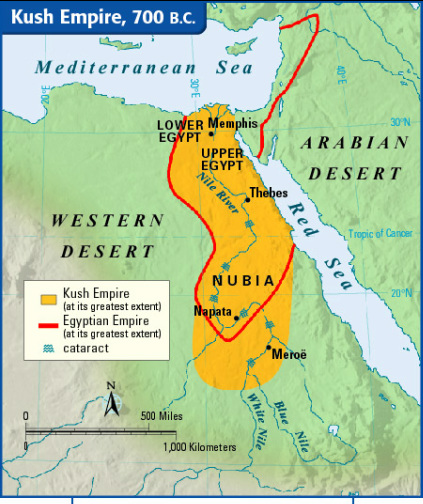
For over a thousand years, the Kingdom of Kush ruled from the Nile's upper cataracts deep into the African interior. Its capitals — first Kerma, then Napata, and finally Meroë — anchored trade routes that ran from the Red Sea to the interior and from the Mediterranean to the sub-Saharan south. Its kings were feared. Its artisans were exceptional. And for nearly a century, its pharaohs sat on the throne of Egypt itself.
This is the story of an African empire that conquered the oldest civilization in the world, ruled it with the confidence of a legitimate dynasty, and then endured for another thousand years after its army was pushed south. It is one of the largest stories of the ancient world. It is also one of the most systematically minimized.
The Kingdom Before the Crown
Kush was never a backwater waiting to be civilized. As early as 2500 BC, the Kerma culture in Upper Nubia had built one of Africa's earliest urban societies, with monumental mudbrick temples, complex royal tombs, and a metallurgy tradition that rivaled Egypt's. By 1700 BC, Kerma was strong enough to raid deep into Egyptian territory during the Second Intermediate Period.
Egypt eventually pushed south under the New Kingdom pharaohs and occupied Kush for several centuries. But Egyptian rule left more than administration behind. It introduced a shared religious world — the worship of Amun, hieroglyphic writing, pharaonic titulary — that Nubians absorbed, adapted, and eventually turned back on their former rulers.
When the New Kingdom collapsed around 1070 BC, Egypt fragmented into rival dynasties. Kush did not. The old Egyptian outpost at Napata, near the fourth cataract, became the capital of a resurgent Nubian kingdom whose priests still worshiped Amun and whose kings still claimed the language of pharaohs. They were watching Egypt fall apart, and they were waiting.
Piye and the Restoration of the Two Lands
Around 747 BC, a Kushite king named Piye — sometimes called Piankhi in older scholarship — inherited a strong kingdom, a well-trained army, and a claim to religious legitimacy across the entire Nile Valley. When one of Egypt's northern rulers, Tefnakht of Sais, began consolidating power in the delta, Piye marched north.
His campaign is described in extraordinary detail on the Victory Stela of Piye, a black granite monument discovered at Gebel Barkal near Napata. It is one of the longest and most vivid royal inscriptions to survive from the ancient world. Piye besieged Hermopolis, defeated a coalition of northern rulers, and entered Memphis. He then made a point of visiting the temples of Amun, purifying himself, and offering sacrifices — not as a conqueror, but as a pharaoh restoring the sacred order.
The 25th Dynasty had begun. For the first time in centuries, a single king ruled the entire Nile Valley from the delta to the fourth cataract. And that king was Nubian.
Taharqa and the Golden Age
The 25th Dynasty produced a line of remarkable rulers. Shabaqo consolidated Piye's conquests and stabilized the administration of Egypt. Shebitqo drew the empire into alliance with the small kingdoms of the Levant against Assyria. But the reign that defined the dynasty belonged to Taharqa, who ruled from about 690 to 664 BC.
Taharqa built on a scale not seen in Egypt for centuries. His temple additions at Karnak, including the towering kiosk in the first court, remain among the most monumental structures at the site. He built new temples at Kawa and Gebel Barkal. He restored the cult of Amun across both Egypt and Nubia. Under his reign the Kushite pharaohs were not visitors playing at Egyptian religion. They were its patrons.
Taharqa is also named in the Hebrew Bible. In 2 Kings 19:9, he appears as "Tirhakah, king of Cush," leading an army against the Assyrian king Sennacherib during his campaign in Judah in 701 BC. The confrontation shaped a geopolitical world stretching from the upper Nile to the Jordan. This was an African pharaoh operating on the widest stage the ancient Near East offered.
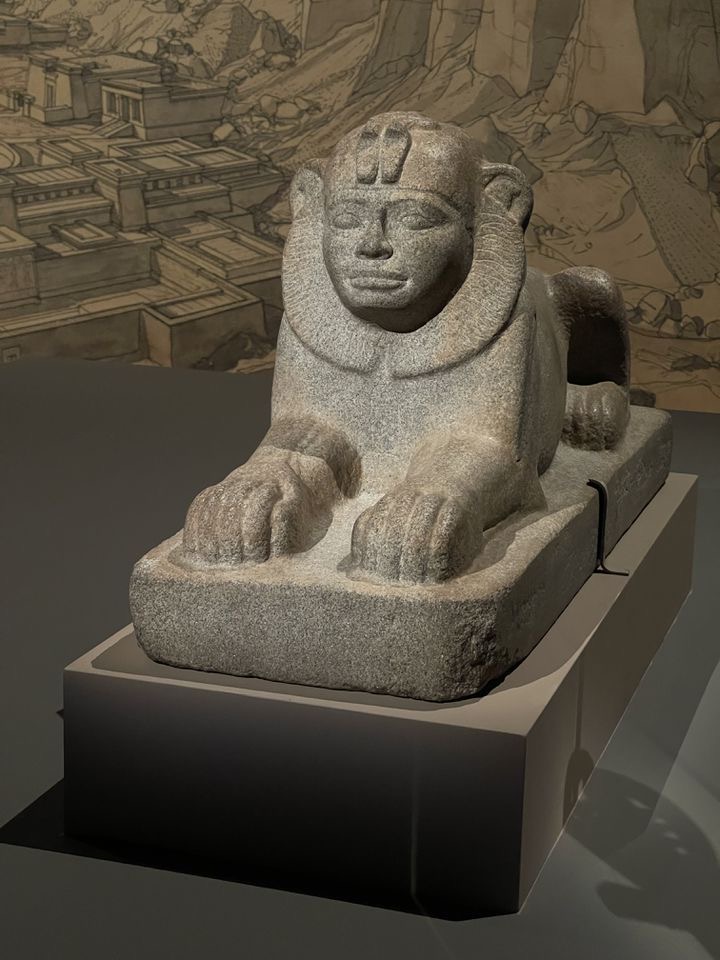
The Shabaqo Stone and the Memphite Theology
Between Piye and Taharqa stood Shabaqo, who ruled from about 716 to 702 BC and moved the seat of the 25th Dynasty north to Memphis. He is remembered above all for a single object: a slab of black granite, discovered in the nineteenth century and now held in the British Museum, that preserves one of the oldest surviving works of Egyptian theology. Its opening inscription states that Shabaqo ordered the text copied onto stone because the original papyrus was being eaten by worms.
The text, known as the Memphite Theology, argues that the god Ptah of Memphis created the world through thought and speech — an intellectual creation myth that anticipates by more than two millennia the opening lines of the Gospel of John. A Kushite pharaoh, ruling from an African capital deep in Sudan, went out of his way to preserve one of the most sophisticated pieces of ancient Egyptian religious philosophy. That is not the act of an occupier. It is the act of a monarch who understood himself as guardian of a civilization he had inherited.
The Assyrian War and the Long Retreat
Kush's hold on Egypt provoked the largest military power of the era. Assyria had built an empire on iron weapons, cavalry, siege engines, and a discipline of cruelty that ancient writers found difficult to describe. Beginning in the 670s BC, Esarhaddon and later Ashurbanipal launched a series of invasions of Egypt.
Taharqa held out for years, retreating and returning, retaking Memphis and losing it again. His successor Tanwetamani won a final northern victory before the Assyrians returned in 664 BC and sacked Thebes, the greatest religious city in the ancient world. The trauma of that sack echoed for generations across the Near East.
The 25th Dynasty pharaohs withdrew south, beyond the first cataract, back to their Nubian heartland. Egypt fell under new Assyrian client rulers, then under native Egyptian dynasties, and eventually under Persia and Greece. But Kush did not collapse. It shifted its capital farther south to Meroë, kept its ceremonies, and continued to rule for almost another thousand years.
Meroë: The Long Afterlife of an African Empire
From roughly 300 BC to 350 AD, Meroë was one of the great cities of the ancient world. Its ironworks produced weapons and tools on a scale that impressed classical writers, who called Meroë the "Birmingham of ancient Africa." Its royal cemeteries at Begarawiyah still contain more than two hundred pyramids, more than Egypt possesses in its entire history.
Meroë developed its own writing system, Meroitic, an alphabet distinct from Egyptian hieroglyphs. Its queens — the kandakes — were sovereigns in their own right, and one of them famously defeated a Roman raiding force in the first century BC. Meroitic ambassadors visited Rome, Ptolemaic Alexandria, and Aksum. The kingdom that had ruled Egypt in the eighth century BC survived, adapted, and remained a major African power until its eventual eclipse by the rising empire of Aksum.
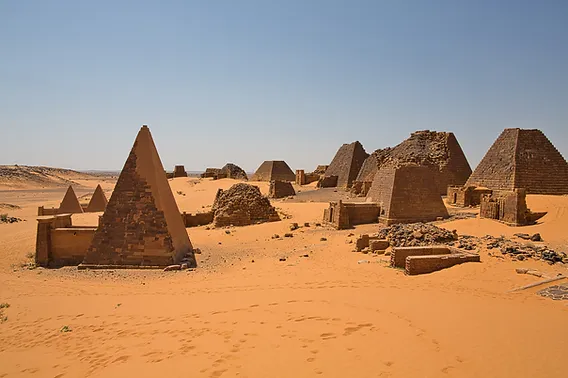
The Kandakes: Queens Who Faced Rome
The Meroitic state was one of the few ancient societies in which women regularly held sovereign power. The Greek and Roman sources called them kandakes, a Latinization of the Meroitic kdke, meaning queen mother or ruling queen. At least seven queens governed Meroë in their own right between the third century BC and the first century AD.
The most famous is Amanirenas, who ruled around 40–10 BC. When the Roman prefect Gaius Cornelius Gallus began pressing south of Egypt's new frontier, she launched a preemptive campaign. In 24 BC her armies overran the Roman garrisons of Syene, Elephantine, and Philae, took thousands of prisoners, and pulled down a bronze statue of Augustus at Syene. The head of that statue, its enamel eyes still intact, was buried beneath the threshold of a temple at Meroë — a permanent humiliation for every visitor who crossed into her palace.
Rome retaliated under the prefect Gaius Petronius, who marched south, sacked Napata, and forced negotiations. But the treaty Amanirenas secured at Samos in 21 BC was extraordinary: Rome withdrew its garrisons, returned Meroitic captives, and remitted tribute. She is described in ancient sources as one-eyed and formidable. Her successor Amanishakheto continued to build monumental pyramids at Wad ban Naqa whose jewelry hoards — recovered by Giuseppe Ferlini in 1834 — remain among the finest goldwork of the ancient world.
What the Stones Show: Reisner, Nuri, and El-Kurru
Modern knowledge of the 25th Dynasty rests largely on the excavations directed by George Reisner between 1916 and 1919 at the royal cemeteries of El-Kurru, Nuri, and Gebel Barkal. At El-Kurru he identified the tombs of Piye, Shabaqo, and Tanwetamani, arranged in a clear dynastic sequence. At Nuri he uncovered the pyramid of Taharqa, the largest Kushite royal tomb ever built, its underground chambers cut deep into bedrock and once filled with shabti figurines, gold jewelry, and inscribed vessels.
The finds settled a long debate. Kushite kings were not buried in Egyptian style as an act of imitation. They combined pharaonic iconography with distinctly Nubian burial practices: horse burials at the entrances of their tombs, cap-crowns with a double uraeus, and figures that show them wearing the ram-headed amulet of the Kushite Amun. The material culture belongs to a coherent Nubian royal tradition that treated Egypt's throne as one of several legitimate expressions of that tradition.
Why History Forgot This
For generations, Western Egyptologists treated the 25th Dynasty as an interruption in an otherwise Egyptian story. They called the Kushite kings "Nubian conquerors" or "Ethiopian invaders" rather than pharaohs. They framed a period of Egyptian reunification as a foreign occupation. The message was subtle but unmistakable: real civilization flowed from the Mediterranean north, not from the African south.
Nineteenth-century racial theory hardened these framings into doctrine. Scholars trained in the era of the transatlantic slave trade and European colonial expansion could not easily accept that a Black African dynasty had ruled and legitimately claimed the pharaonic throne. So they qualified the record, minimized the monuments, and tucked the whole story into a footnote called the "Ethiopian interlude."
But the inscriptions name the kings. The temples still stand. The pyramids remain.
Why This Matters
The Kingdom of Kush matters because it collapses one of the most persistent lies of world history: the idea that Africa south of the Sahara had no complex civilizations before European contact. Kush ran an urban economy, minted royal monuments, patronized international religion, and negotiated with the largest empires of its time. It did this for well over a thousand years.
It also matters because Egypt itself, the civilization most non-African cultures will readily celebrate, was never sealed off from the African south. The Nile connected them. The same river that fed Memphis fed Napata. Recognizing the Kushite pharaohs as legitimate pharaohs is not a redistribution of prestige — it is simply reading the inscriptions the way their authors wrote them.
Legacy
Kush conquered and ruled the oldest continuous civilization in the world. For nearly a century, a Nubian dynasty controlled the Nile from the Mediterranean to the deep interior of Africa. When it lost Egypt to Assyrian iron, it did not collapse. It withdrew, endured, and reinvented itself at Meroë for another millennium. Its pyramids still stand. Its inscriptions still speak.
History forgot this part. But the stones remember.
Suggested Reading
- László Török — The Kingdom of Kush: Handbook of the Napatan-Meroitic Civilization
- Derek A. Welsby — The Kingdom of Kush: The Napatan and Meroitic Empires
- Robert G. Morkot — The Black Pharaohs: Egypt's Nubian Rulers
- Timothy Kendall — Kush: Lost Kingdom of the Nile
- Julie Anderson & Salah Mohamed Ahmed — Ancient Sudan: Nubia
- Stanley Burstein — Ancient African Civilizations: Kush and Axum
Primary Historical Sources
- The Victory Stela of Piye (Gebel Barkal, c. 727 BC)
- The Shabaqo Stone / Memphite Theology (British Museum EA 498)
- Temple inscriptions of Taharqa at Karnak, Kawa, and Gebel Barkal
- The Hebrew Bible — 2 Kings 19 and Isaiah 37 (Tirhakah of Cush)
- Assyrian royal annals of Esarhaddon and Ashurbanipal
- Strabo — Geography, Book XVII (accounts of Meroë and the kandakes)