FAITH & EMPIRE
Ethiopia's Imperial Church Before Colonialism
A faith that crowned kings, composed scripture, and outlasted every empire that tried to erase it.
14 min read
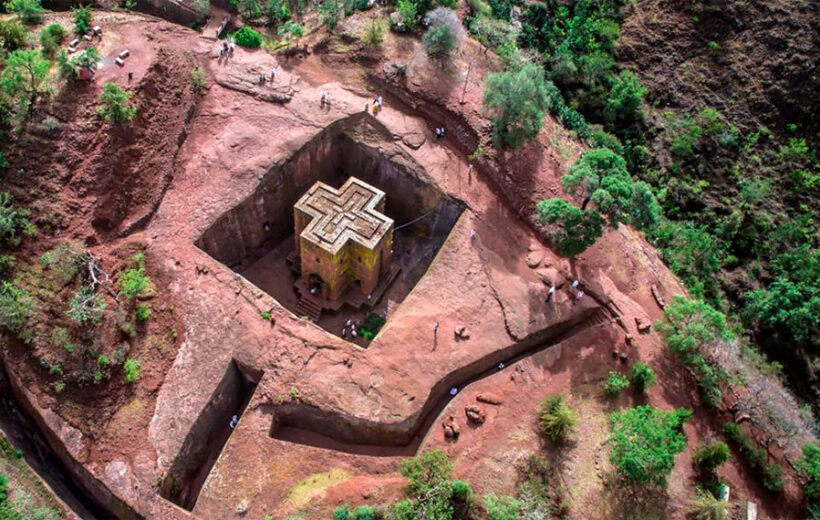
Before Italian colonialism reshaped the Horn of Africa, the Ethiopian Orthodox Church had already shaped empires for 1,500 years. It was not a passive faith. It crowned kings, composed scripture, and declared theology that shaped kingdoms.
To understand Ethiopian Christianity is to understand a religion that was never delivered by missionaries and never subordinated to a foreign patriarch. It grew inside an African kingdom that answered to no one across the sea. It wrote its own scriptures, sang its own hymns, and stood at the center of one of the longest continuous imperial traditions in world history.
For most of that history, the church and the crown were not separate institutions. They were a single machine of memory and power, running through Aksum, Lalibela, Gondar, and Addis Ababa across fifteen centuries.
Aksum: The Church That Survived Rome
Christianity reached the Ethiopian highlands in the fourth century, when King Ezana of Aksum accepted the faith and made it the religion of his court around 330 AD. That was almost a hundred years before the Roman Empire in the west collapsed, and long before most of Europe had heard the gospel in its own tongue. From the beginning, Ethiopian Christianity grew inside an African kingdom that answered to no one across the sea.
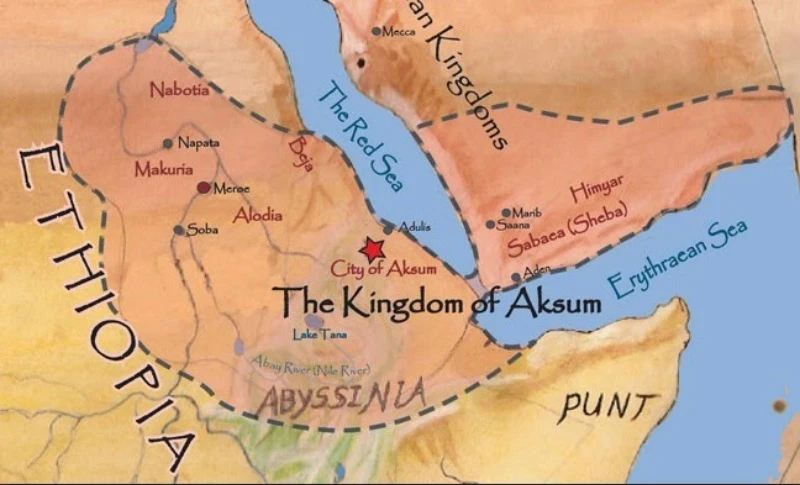
Aksum at its height was a maritime empire. Its port of Adulis on the Red Sea connected the highlands to Roman Egypt, Ptolemaic Alexandria, southern Arabia, and the Indian Ocean trade. The Persian prophet Mani, writing in the third century, listed Aksum among the four great kingdoms of the world alongside Rome, Persia, and China. King Ezana's coinage bears one of the earliest crosses of any Christian state on earth.
Its earliest bishops were consecrated in Alexandria, tying Ethiopia into the Coptic world of North Africa. But the church did not stay a satellite of anywhere. It developed its own liturgy in Ge'ez, its own calendar, its own fasts, its own sacraments. It kept practices that the wider Christian world quietly abandoned: the Ark of the Covenant at the heart of every altar, ritual observance rooted in the Hebrew Bible, an ordered monastic life that stretched from cliffside cells to walled communities.
When the Council of Chalcedon divided Eastern and Western Christianity in 451, Ethiopia held with the miaphysite tradition of Alexandria. That choice set it apart from Rome and Constantinople for the rest of history. It also made the Ethiopian Church a full theological actor in its own right, not a distant province of anyone else's faith.
Frumentius and Ezana: How the Cross Reached Aksum
The conversion of Aksum is recorded in a story that mixes accident and design. In the early fourth century, according to the church historian Rufinus writing around 402 AD, a Syrian Christian named Frumentius was shipwrecked on the Red Sea coast as a young man and taken to the Aksumite court. He rose through the royal household as tutor and secretary to the young prince who would later reign as King Ezana.
When Ezana came to power, Frumentius traveled to Alexandria and asked the patriarch Athanasius — the same Athanasius who defended Nicene orthodoxy against Arianism — to send a bishop to Ethiopia. Athanasius consecrated Frumentius himself, sending him back to Aksum around 340 AD as the first bishop of the Ethiopian church. He is remembered in Ge'ez tradition as Abba Salama, Father of Peace, and his tomb is venerated in Tigray to this day.
Ezana's own inscriptions record the change. Earlier stelae invoke the god Mahrem, the Aksumite war deity. Later stelae, including the Ezana Stone that still stands in Aksum, open by naming the Lord of Heaven. His silver and copper coinage shifts in the same period from a disc-and-crescent emblem to the cross — one of the earliest official uses of the cross on any state coinage in the world, minted inside Africa before most of Europe had received the gospel.
Scribes and Saints Who Built the Canon
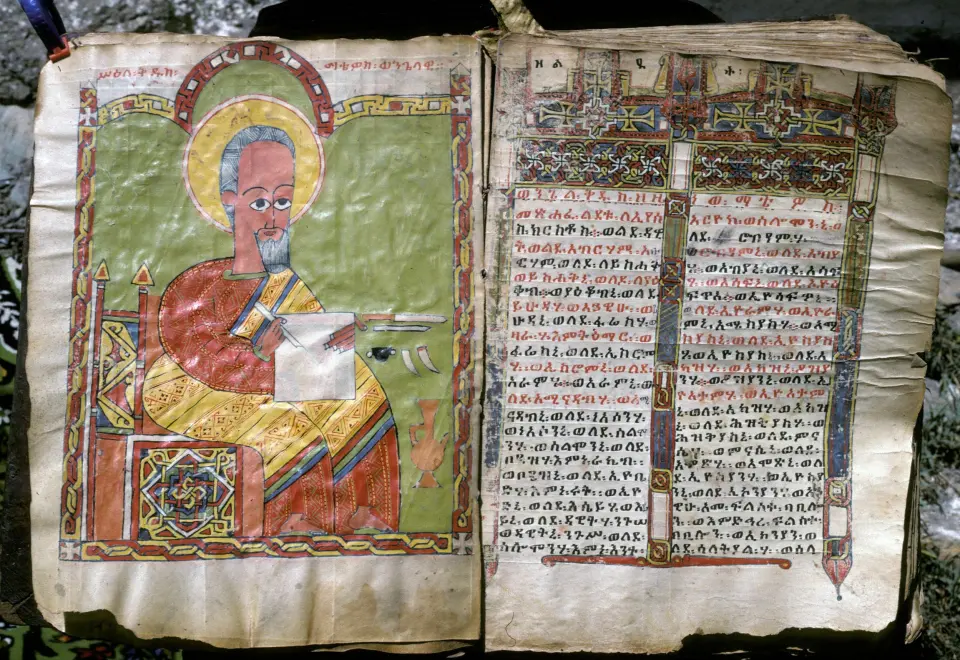
Ge'ez was not only a liturgical language. It was a working scholarly tradition. In the cliffs of Tigray, in the island monasteries of Lake Tana, in the great scriptoria of Debre Libanos and Debre Damo, monks copied scripture, translated theology, and composed original works of hagiography, hymnody, and law.
The Ethiopian biblical canon is one of the widest in the Christian world. It preserves eighty-one books, including works such as 1 Enoch and Jubilees that circulated in the ancient Near East and then disappeared almost everywhere else. Without Ethiopian scribes, entire strands of early Jewish and Christian thought would have been lost to modern scholarship. When European scholars rediscovered the complete text of 1 Enoch in the eighteenth century, they found it in an Ethiopian monastery.
Saints like Yared, who is credited with composing the sacred music of the church in the sixth century, and the Nine Saints, who arrived from the Byzantine world in the late fifth century and founded a network of monasteries that translated scripture into Ge'ez, are more than pious legends. They mark a national tradition that treated literacy, prayer, and craft as inseparable acts. To be a scribe was to be a servant of the crown, the altar, and the memory of the kingdom at once.
Lalibela and the Sacred Landscape of the Zagwe
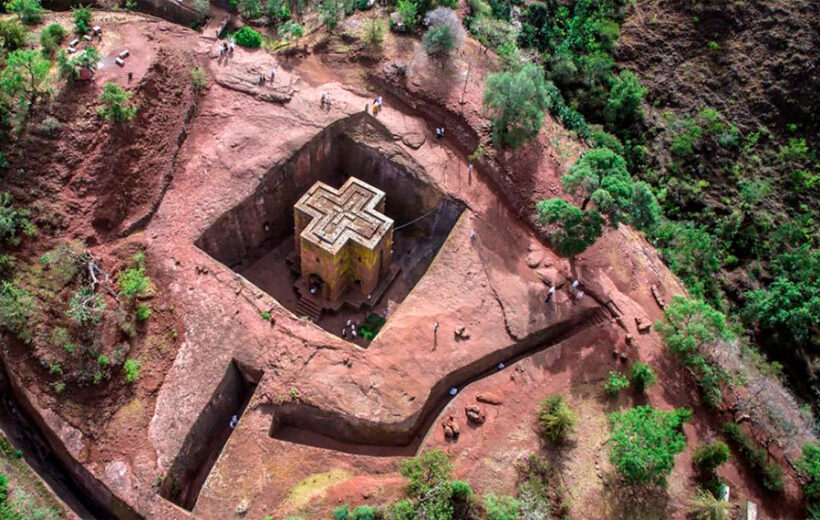
Around 1200 AD, the Zagwe king Lalibela commissioned a project that has no parallel in medieval Christianity. Eleven churches were carved directly downward into the red volcanic rock of the highlands, each one hewn from a single block of stone. The largest, Bete Medhane Alem, is still the largest monolithic church in the world. The most iconic, Bete Giyorgis, was cut into the shape of a cross visible from above.
The complex was designed as a new Jerusalem for pilgrims who could not or would not travel to the Holy Land after Muslim reconquest cut off many pilgrimage routes. Streams carved through the site were given the name of the River Jordan. Chapels were named after Bethlehem and Golgotha. Ethiopia declared itself a full theological landscape, capable of hosting the sacred story on its own soil.
Modern engineers still debate how the churches were built with the tools available. Ethiopian tradition attributes the work to angels who continued at night what human workers achieved by day. Either way, the finished sanctuary confirmed a claim that the Ethiopian Church has never abandoned: that this highland was itself a holy land.
The Church as Political Power
In imperial Ethiopia, no emperor ruled alone. The Solomonic dynasty, which claimed descent from the union of King Solomon and the Queen of Sheba, drew its legitimacy from the Kebra Nagast, the fourteenth-century national epic composed and preserved by the church. To be anointed at Aksum, to receive the crown from the hands of a bishop or an abbot, was to be recognized as the rightful heir of a sacred lineage.
Church and crown moved as partners across centuries of conquest, reform, and civil war. Abbots served as royal counselors. Bishops mediated disputes among nobles. The church held vast lands, ran schools, adjudicated marriage and inheritance, and gave shape to the moral life of the empire. Its councils spoke on doctrine, but they also spoke on succession, on rebellion, on the limits of royal power.
That closeness was not always peaceful. Emperors and patriarchs clashed over appointments, taxes, and reform. Kings like Zara Yaqob in the fifteenth century tried to bring the church tightly under royal control and to standardize its doctrine. Later monarchs found the same institution pushing back against them. The tension between throne and altar was constant, and it was one of the engines of Ethiopian history.
Zara Yaqob: The Theologian King
No emperor embodied the fusion of throne and altar more completely than Zara Yaqob, who ruled from 1434 to 1468 AD. Educated in a monastery before his coronation, he was as much a theologian as a monarch. He convened the Council of Debre Mitmaq in 1450 to settle disputes over the observance of the Sabbath, ruling that Ethiopian Christians should honor both Saturday and Sunday — a compromise that reflected the church's deep Judaic inheritance.
Zara Yaqob personally authored a series of theological works in Ge'ez that circulate still: the Mashafa Berhan (Book of Light), the Mashafa Milad (Book of the Nativity), and the Mashafa Bahriy (Book of the Essence). He standardized liturgical practice, expanded the cult of the Virgin Mary, ordered every Christian to bear the mark of a cross tattooed on the arm or forehead, and pursued heretics and remnants of traditional religion with sometimes brutal severity.
He also received a Coptic delegation from Alexandria and sent envoys to the Council of Florence in 1441 AD, where Ethiopian representatives argued their case to Pope Eugene IV — one of the earliest documented diplomatic contacts between the Ethiopian court and Latin Christendom. His reign left the church stronger, wealthier, and more literarily productive than it had ever been.
Resilience Through Invasion and Occupation
In the sixteenth century, the Muslim Adal Sultanate under Ahmad ibn Ibrahim al-Ghazi launched a decade-long war against Christian Ethiopia. Monasteries burned. Manuscripts were lost. The empire barely survived, and it did so only with help from Portuguese soldiers and, more importantly, by re-anchoring itself in the highland monasteries that had preserved its texts.
By the late nineteenth century, European powers were carving up the continent. In 1896, Ethiopian forces under Emperor Menelik II defeated an Italian invading army at Adwa. The victory was decisive, and the church was in the middle of it. Priests blessed the troops. Monasteries fed and sheltered them. The Ark and the icons went to the front. Ethiopian Christianity was not decoration on a national war. It was one of the things the nation was fighting to keep.
When Italy returned in 1935 and occupied the country for five years, the church paid for that identity in blood. Fascist forces massacred hundreds of clergy at Debre Libanos in 1937 in a deliberate attempt to break the spine of the institution. They failed. Parish priests, wandering monks, and lay believers kept the liturgy alive in villages, in exile, and in the resistance.
When occupation ended, the church remained. It re-established its independence from the Coptic patriarchate of Alexandria in 1959, consecrating its own patriarch for the first time in its history. It carried Ethiopia's claim of unbroken sovereignty into the modern era. Almost no other African institution can say the same.
Why This Matters
The Ethiopian Orthodox Church breaks the assumption that African Christianity is something European or Middle Eastern that eventually arrived on the continent. In Ethiopia, Christianity is African. It was adopted as a state religion before most European kingdoms existed. It produced its own scripture, its own liturgy, its own architecture, and its own theology inside an African imperial tradition that ran unbroken for more than a millennium and a half.
Recognizing that story matters for how we understand African history, the history of Christianity, and the history of resistance to European colonization. Ethiopia is the only African country that was never fully colonized. That fact is inseparable from the church that stood at the center of its identity.
Legacy
The Ethiopian Orthodox Church is not a curiosity. It is one of the oldest continuously functioning Christian institutions on earth, older than most cathedrals in Europe, older than most nation-states anywhere. It preserved books the rest of the world lost. It anchored an empire that resisted colonization when the rest of the continent could not. It built a culture of scholarship, liturgy, and craftsmanship that still fills the highlands with music and light.
Faith was not the thing done to Ethiopia. Faith was the thing Ethiopia did, and kept doing, when every empire around it demanded otherwise.
Suggested Reading
- Stuart Munro-Hay — Aksum: An African Civilization of Late Antiquity
- Getatchew Haile — The Ethiopian Orthodox Tewahedo Church
- Sergew Hable Sellassie — Ancient and Medieval Ethiopian History to 1270
- Donald Crummey — Land and Society in the Christian Kingdom of Ethiopia
- Edward Ullendorff — Ethiopia and the Bible
- Steven Kaplan — The Monastic Holy Man and the Christianization of Early Solomonic Ethiopia
Primary Historical Sources
- The Ezana Stone — royal inscriptions of King Ezana of Aksum, 4th century
- Rufinus of Aquileia — Historia Ecclesiastica, Book X (Frumentius narrative)
- Kebra Nagast — The Glory of Kings, 14th-century national epic
- Fetha Nagast — Law of the Kings, medieval Ethiopian legal code
- Zara Yaqob — Mashafa Berhan (Book of Light), 15th century
- The Ge'ez text of 1 Enoch preserved in Ethiopian monasteries
- Royal chronicles of Zara Yaqob, Susenyos, and Menelik II